Visiting the U.S. Post Office this holiday season? Look up! You might see some New Deal art!

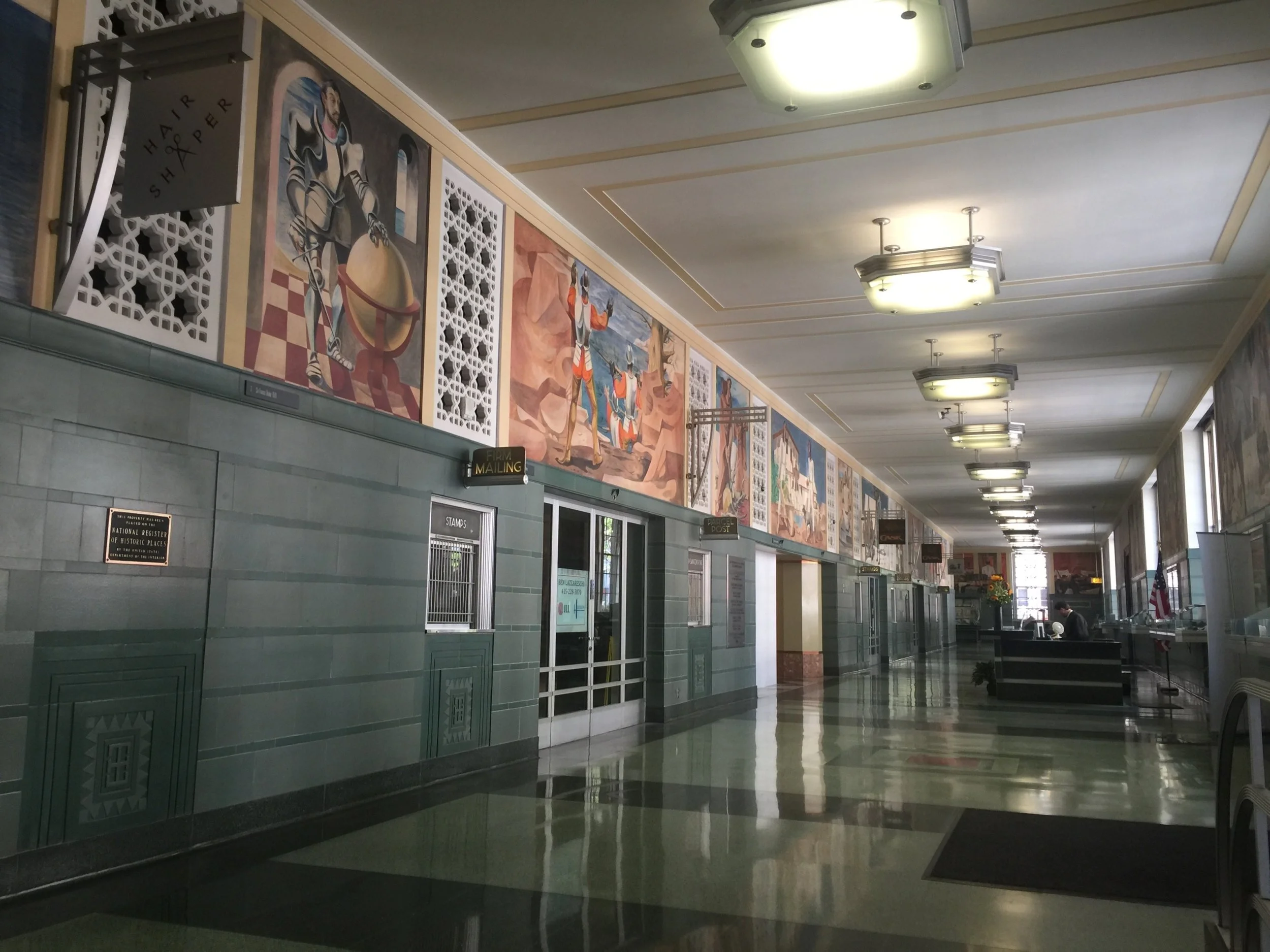
Rincon Annex lobby, former U.S. post office, San Francisco, photo by Gray Brechin (C) creative commons

By Heather Christine Ripley, ADSC Preservation Committee member

If you are visiting your local post office this busy holiday season, you might be lucky enough to be patronizing a New Deal-era post office, complete with a 1930s mural painted in the social realist style. Hundreds of murals were created during the Great Depression, through funding from the Works Progress Administration created by President Franklin Delano Roosevelt. The goal was to promote pride in local industries and history, to give artists much needed work during hard times, and to instill civic pride.

In the San Francisco Bay Area and in the rest of California, there are several examples of 1930s post offices with New Deal art, and some historic murals are located inside Art Deco Society of California Preservation Award winners.

One of our local favorites is the Rincon Annex, a former post office built in 1940, and an ADSC Preservation Award winner in 1989. Designed by architect Gilbert Stanley Underwood (who also designed the Ahwahnee Hotel in Yosemite) in the sleeker Streamlined Moderne style, it opened as a major mail and package handling center on Mission between Spear and Steuart streets in the South of Market neighborhood.

The exterior features leaping dolphins over wavy turquoise bands of tile, black marble surrounding the entrances and gorgeous metal work.

The lobby houses 27 murals by Russian immigrant artist Anton Refregier depicting the history of California, which were not completed until 1948 because of so many controversies and ugly history depicted in his murals. The building, now part of Rincon Center, is no longer a working post office but the lobby is open every day. And if you need to go to the post office, there is one around the corner on Steuart. You can read more about the complex history of Refregier’s murals on the Living New Deal website.
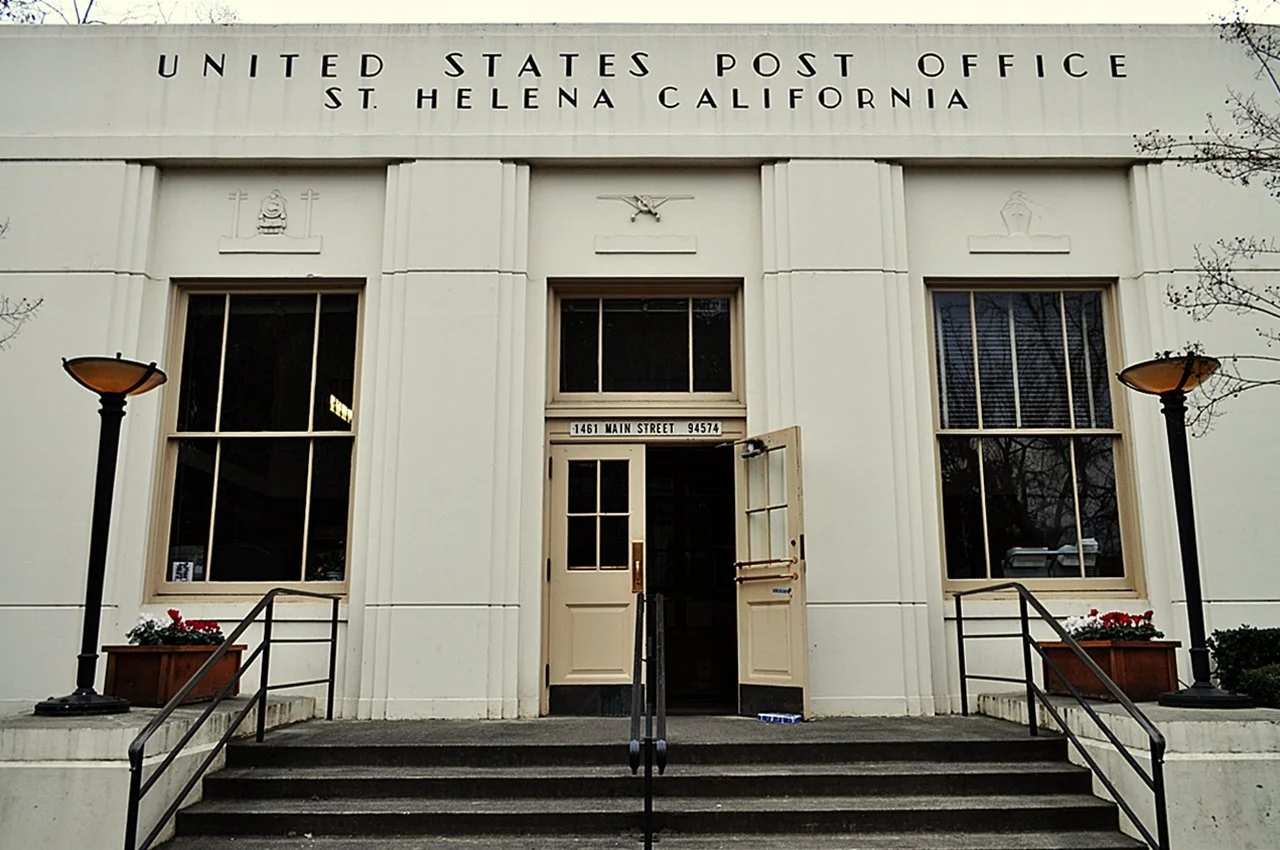
U.S. post office, 1461 Main Street, St. Helena, Ca. Photo by John W. Murphey (c) creative commons

The historic St. Helena Post Office in St. Helena, California was built in 1940–1941 and opened for business in March 1941. It was designed by architect Lewis Simon, who was responsible for the building’s transitional Art Deco/Moderne style typical of small federal post offices of that era. It won an ADSC Preservation Award in 1997.

This post office features a mural called “The Grape Pickers” depicting the wine industry of the Napa Valley, commissioned by the Treasury Section of Fine Arts and painted by Lew Keller. Located in a shallow niche above the Postmaster’s office door in the lobby, the mural was completed in 1943. Decades later, according to the city of St. Helena’s website, another mural in a similar, social realist style, was proposed by local artist Arthur Lisch, to portray the Latino workers that work in the vineyards today. That mural was complete in 1999 and is on the opposite wall of Keller’s mural.
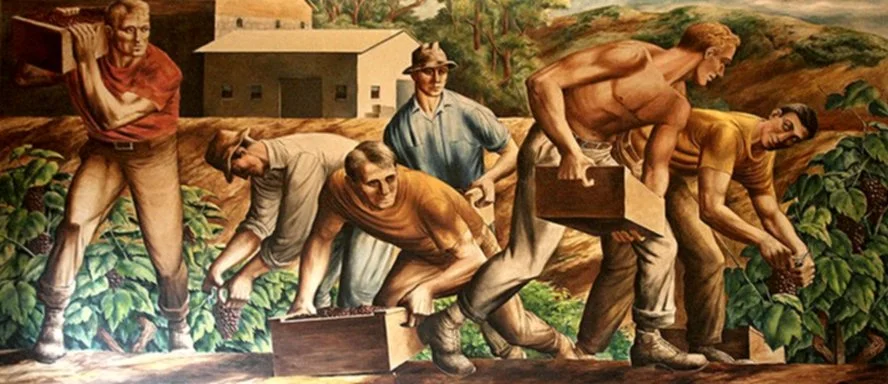
The grape pickers by lew keller, U.S. treasury department, via Wikimedia commons
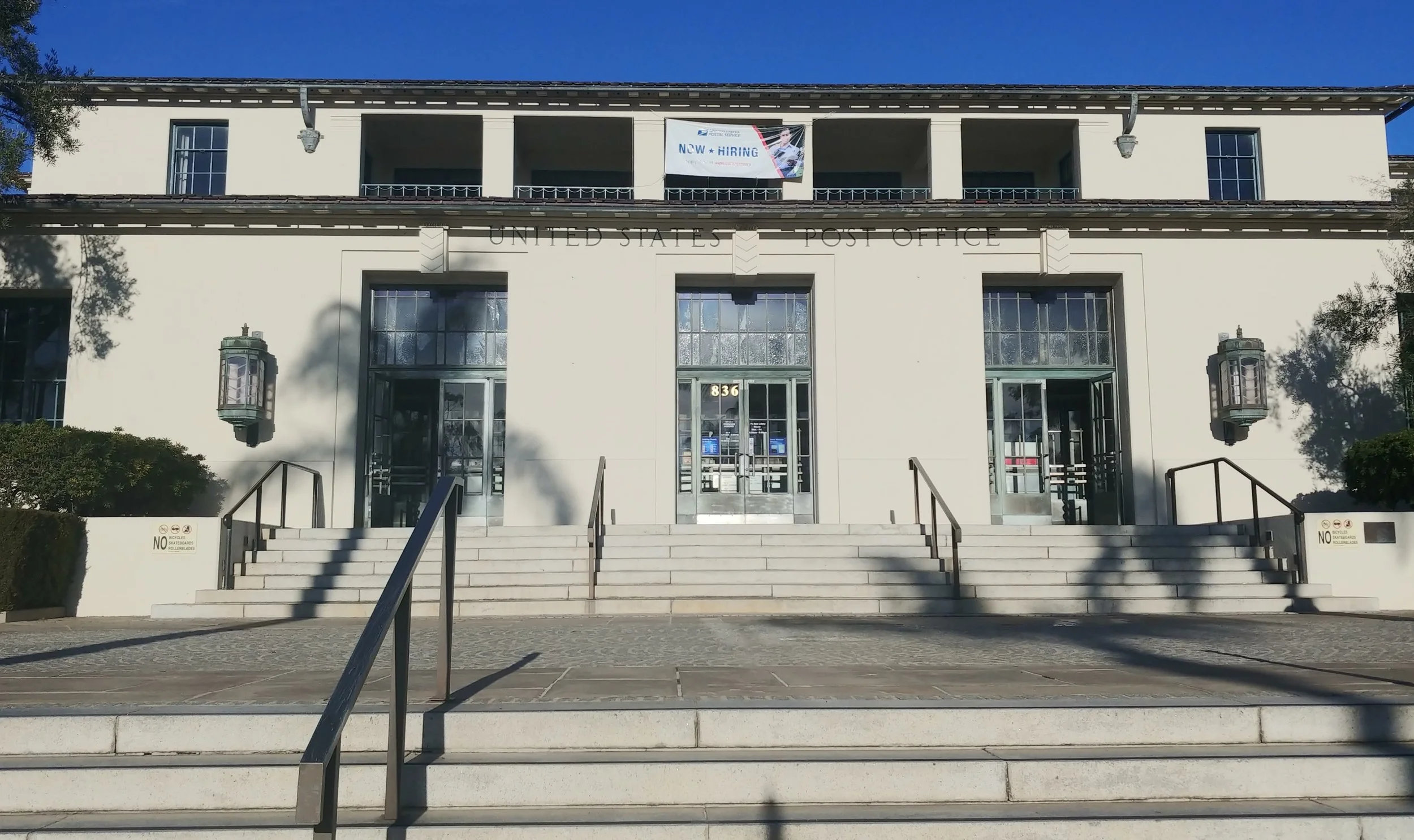
Facade of U.S. Post office, 836 Anacapa St., Santa Barbara, photo by Therese Poletti

While there are no murals, public art still abounds at the Santa Barbara Main Post Office, designed by architect Reginald Davis Johnson, completed in 1937. The Santa Barbara Post Office, which won an ADSC Preservation Award in 2024, is an unusual combination of Spanish Colonial revival style, the dominant architectural style in Santa Barbara, and Streamlined Moderne details, such as in the metal door and window frames and light fixtures.

Inside the lobby, visitors will see the public art in the form of six Streamline Moderne bas-relief panels by artist William Atkinson. They depict themes like “Carrying the Mail” with images of the Pony Express, a stagecoach, a clipper ship, a train, and an airplane, and “The Opening of the West” with the completion of the Transcontinental Railroad. The Santa Barbara Post Office was the subject of a successful preservation battle, when the Postal Service attempted to put the building up for sale.

Bas relief panel inside the Santa barbara post office, “carrying the mail”, Photo national archives and records administration, via the Living new deal

In the Bay Area, you can also visit The Bradford Station Post Office in Hayward on C Street, built in 1936 with federal Treasury Department funds as a New Deal project. It features a distinctive Art Deco style, flattened neoclassical columns and murals from the era and still looks remarkably like this 1940s postcard.
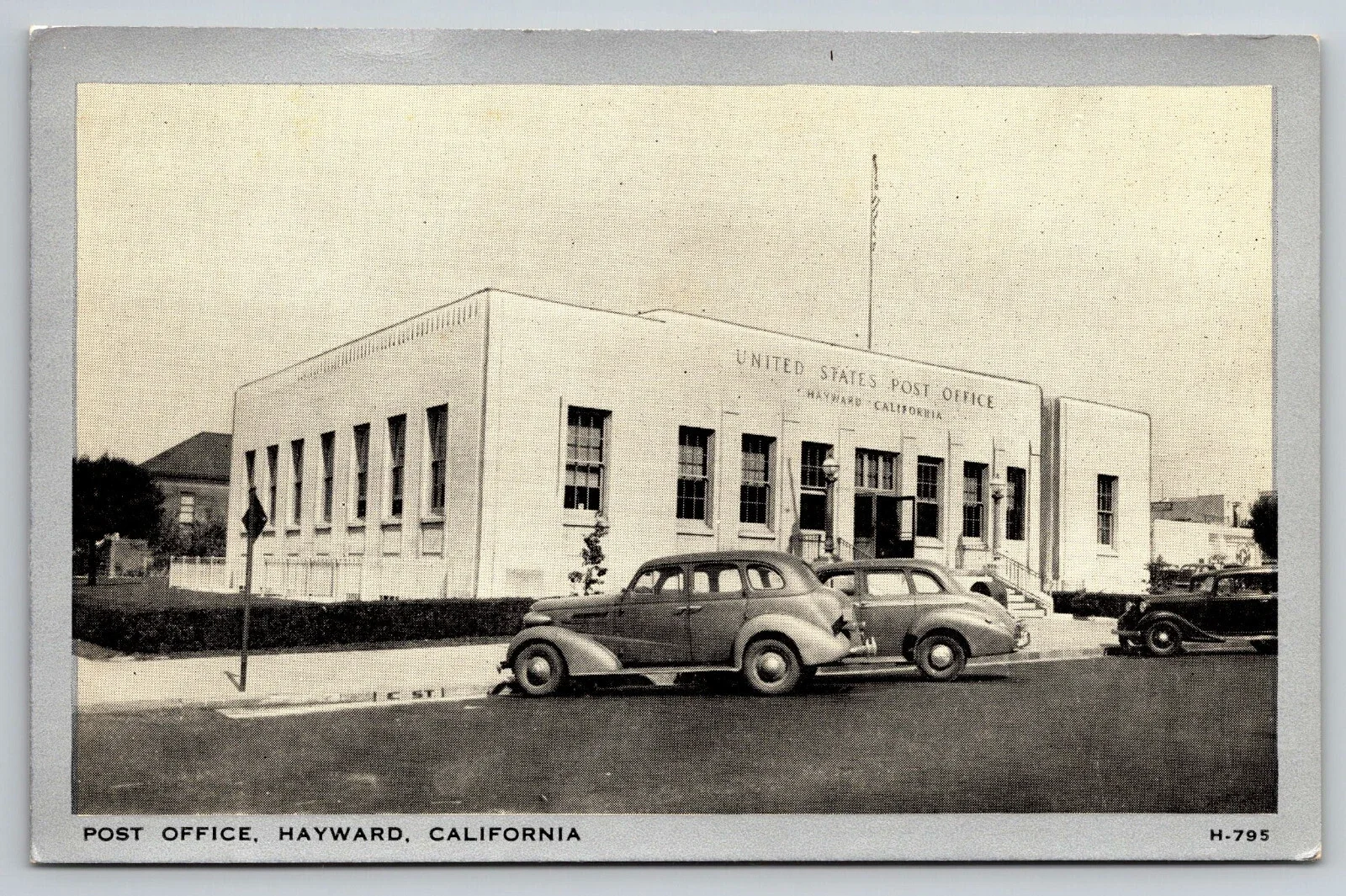
U.s. post office, Bradford Station, C Street, Downtown hayward, vintage postcard, circa 1940s

Inside, a 5’ by 10’ mural called “Rural Landscape” by Tom Lewis from 1938 graces a main wall. It possibly depicts the town of Hayward which consisted mostly of farmland at the time. Lewis was a California-based artist who began painting in the late 1920s, exhibiting widely and helping to organize the Progressive Painters of Southern California.
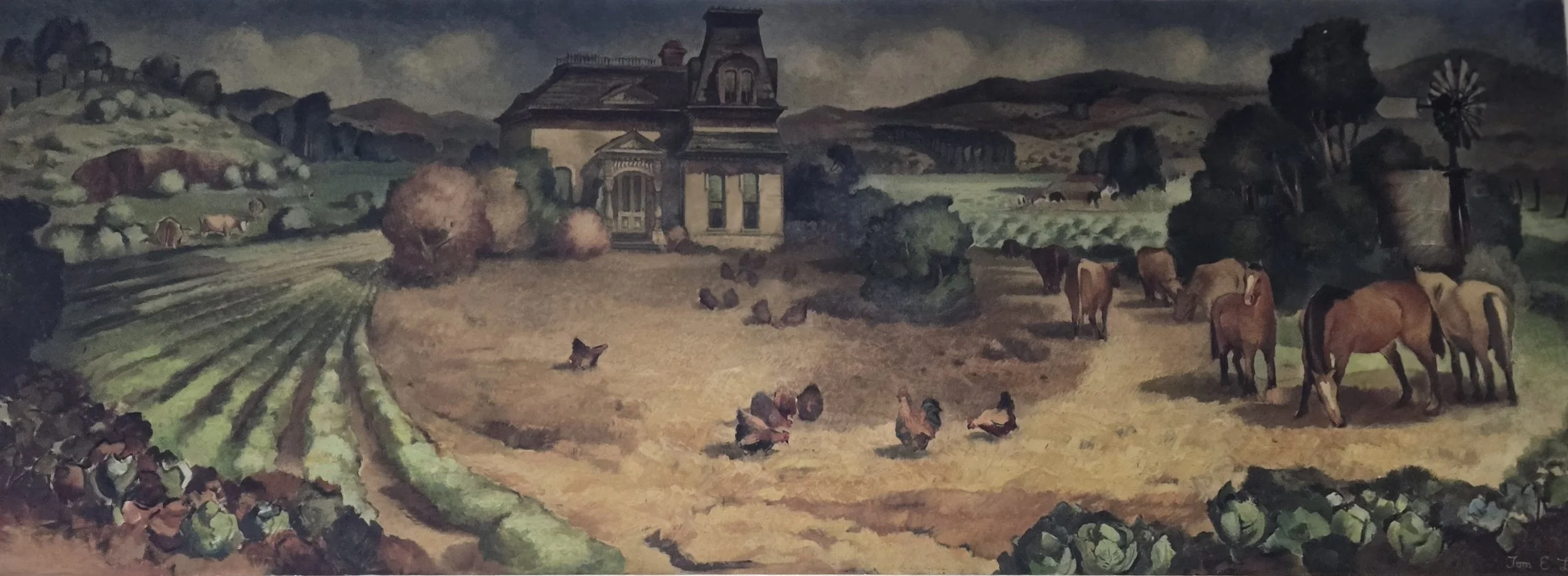
Rural landscape, 1938 mural inside the Hayward post office, by artist Tom Lewis. Photo by Heather christine ripley

Finally, another local Bay Area post office to visit is the Berkeley Main Post Office in downtown Berkeley, which was also the subject of a successful preservation battle, after the U.S. postal service planned to sell the Renaissance Revival post office building built in 1914 to developers. Among the artwork at Berkeley’s beloved post office is a mural by Suzanne Scheuer, created with funding from the Treasury Relief project. Scheuer is probably best known in the Bay Area for her mural “Newspapering” inside Coit Tower. Her mural at the Berkeley Post Office is called “Incidents in California History,” painted in 1936-1937.
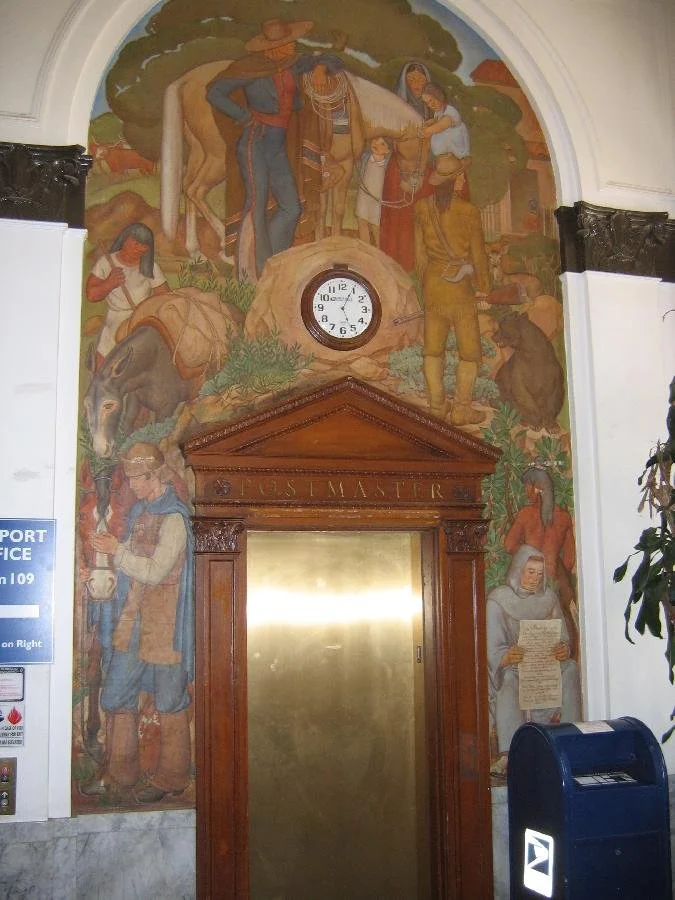
Mural by Suzanne Scheuer in the lobby at the Downtown Berkeley main post office, photo by Gray Brechin

If you want to “branch out,” pun intended, to see more post office murals across the country, Texas-based photojournalist Justin Hamel has traveled across the U.S., documenting post office murals and their civic art. An article in Atlas Obscura includes an interview with him and his website documents murals in cities across the U.S., ranging from Cooper, Texas to Concord, Mass.

Preservation director Therese Poletti also checked in with a mural in a post office in Rockport, Mass., a post office built in the standard Beaux-Arts style, but with a 1939 mural in the lobby, called “Preparing Granite for Shipment,” by artist W. Lester Stevens, an appropriate mural for the New England town that was a once-thriving granite quarrying region.
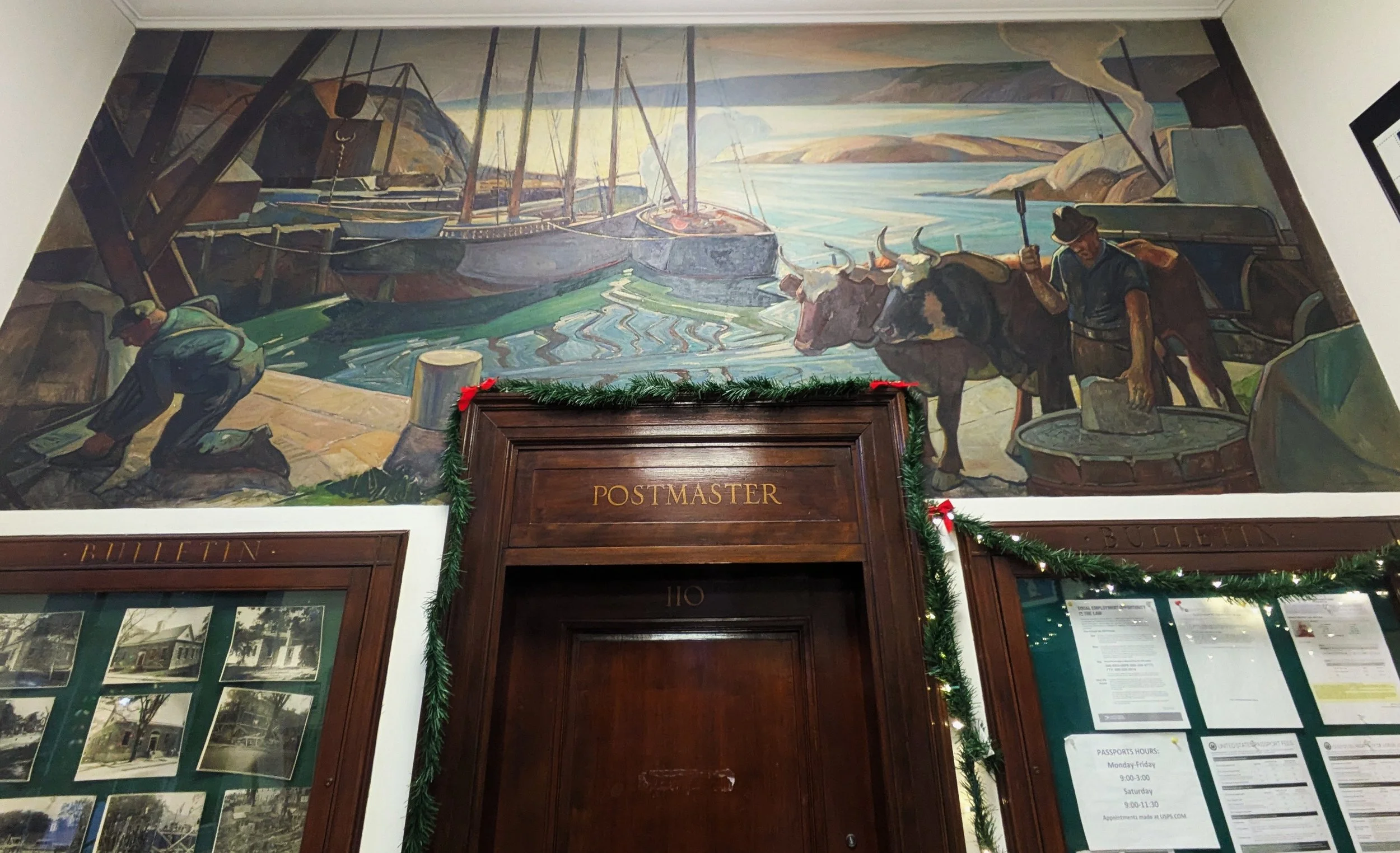
Rockport Post office, mural by W. Lester Stevens, “Preparing for granite shipment,” Photo by Therese Poletti

We would be remiss if at this time of year we did not also thank the postal workers who accept, sort and deliver an incredible amount of mail through post offices across the country. Thank you all for bringing much-needed cheer to millions of Americans this holiday season. Also, visit our friends at the Living New Deal for more information on public works of the 1930s and early 1940s. We thank them for creating such an amazing website with so much research, and to historian/author Gray Brechin for his photos that we used in this post!

Do you have a favorite mural at your local post office? Please share in the comments below!







Song bird Carla Normand featured in audio biography

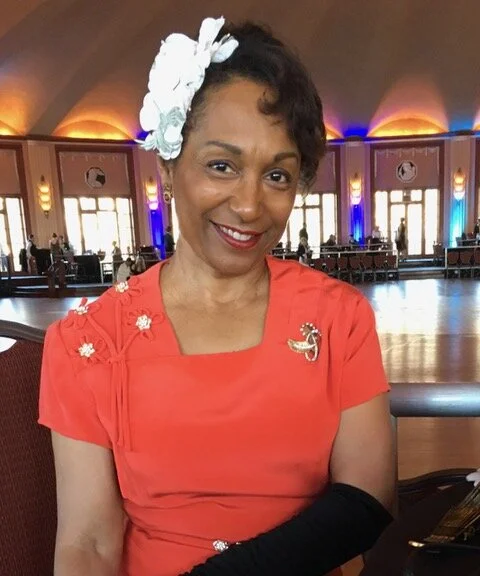
Lovely Carla Normand, the Royal Society Jazz Orchestra’s female vocalist, is the star of “The Carla Normand Story,” an audio biography released this July by Craig Roberts of KCEA radio. The 73-minute long program can be heard or downloaded for free here. The program is an engaging window on some of Normand’s favorite songs, her musical influences and personal history.

Carla Normand is a two-time Art Deco Society of California Preservation Award winner, in 2002 as a member of the RSJO, and in 2024 for her own major contributions to musical preservation, interpreting the repertoire of 1920s and 1930s dance music, with impeccable period styling and a clarity of tone and phrasing that is simply “too marvelous for words.” Roberts is also an Art Deco Preservation Award winner for his promotion of Deco-era music in radio.

Appearing with the RSJO since 1975, Normand also made a wonderful solo album, “Just You, Just Me.”

The RSJO is retiring this year, but we are so grateful to have had their music as the amazing soundtrack for so many years of ADSC events. Presently, contributions to Carla’s GoFundMe are welcome, as she battles Parkinson’s disease while always doing her best to stay “on the sunny side of life.”

We wish Carla all the best! Please visit her page and send her your well-wishes.

San Francisco’s Maritime National Park gets well-deserved spotlight in a documentary

Maritime national park in San francisco, a streamlined moderne treasure, gets its due in a documentary. Photo By Therese poletti

San Francisco’s finest example of Streamline Moderne architecture will be in the spotlight in a new documentary about the history and the art of the Aquatic Park Bathhouse, today known as the Maritime National Park.

The documentary, “A Balcony on the World,” will air on August 22 on KQED at 8 pm and tells the story of the creation of the bathhouse as a democratic country club, a public place for leisure and art. A major project of the Works Public Administration (WPA), the building sits on its lagoon site like an ocean liner ready to depart.

In addition to the stunning nautical architecture by father and son architects William Mooser II. and William Mooser III, the former bathhouse also contains a feast for the eyes of New Deal-era works by artists Hilaire Hiler, Sargent Johnson, Benny Bufano and others in the form of dreamy murals, stunning mosaics and sculpture.

Sargent Johnson’s mosaics provides a colorful backdrop for benny bufano’s sculpture on the veranda photo by THerese Poletti

Completed in 1939, the noble aspirations of a public bathhouse did not last long. The city leased most of the building to a group of businessmen who created an Aquatic Park Casino, a restaurant and nightclub, discouraging public use of the building. The artists were enraged and Johnson stormed off the project, leaving his mosaics unfinished.

During World War II, a command responsible for defending the West Coast was established there. Eventually, in 1988, the site, including the former bathhouse became a National Historic Park. It is now under the auspices of the National Parks Service, which has completed many rehabilitation and restoration projects. Some of these stories may be told in what promises to be a visually rich documentary by filmmaker John Rogers, partly funded by SF National Maritime Park Association President Darlene Plumtree.

The SF National Maritime Park Association is also hosting a world premiere of “A Balcony on the World,” this Saturday evening, August 16, at 7:15 at the Presidio Theatre in San Francisco. Space is limited but there may still be free tickets available. Filmmaker Rogers will be in attendance.

The SF Maritime National Park won an Art Deco Society of California Preservation Award in 1986, and art conservator Ann Rosenthal won an award in 2022 for her work, which included restoration work on many of the murals in the lobby and uncovering new art work upstairs.

Over 40 years of honoring Art Deco preservation at the ADSC

ADSC founder Michael Crowe in 1984 with Preservation Award winner Steve Levin and Sara Klotz de Aguilar, Miss 1929

This year, as we celebrate 100 years of Art Deco, with the centennial anniversary of the Paris Exposition of 1925, the Art Deco Society of California is also celebrating its long commitment to preservation.

As part of the Art Deco Preservation Ball this year, the ADSC’s Preservation Committee, through the efforts of volunteer extraordinaire Heather Ripley, with help from Isabella Miller and Therese Poletti, created a slideshow to look back at the last 40 years of our Preservation Awards. Buildings, businesses, non-profits and individuals who have worked hard to preserve the beauty of the Art Deco era have been honored.

The two slideshows we have compiled do not include every single ADSC award winner, but we have included most of them. The latest slideshows can be found in the Preservation Awards section of our website, including a separate slideshow featuring the winners of 2025. A few featured winners of the past include movie palace architect S. Charles Lee, iconic Deco artist Erté, and architect Milton Pflueger, the youngest brother of Timothy Pflueger, who took over the firm after Tim’s sudden death in 1946.

Looking ahead, do you have any nominations for 2026? You will find any easy-to-use form to nominate any buildings, projects, people for next year’s Art Deco Preservation Awards, also in the Preservation Awards section of the ADSC website.


A New Era for Gatsby!

Turning the Page After 40 Years

Same Grandeur - New Venue

As some of you may have noticed, the Gatsby Picnic location has changed to History Park in San Jose for 2025. Some people are asking why this happened. Ultimately, the decision came down to health and safety concerns at the former location. While Dunsmuir is a lovely location that has served us well for nearly 40 years, there have been concerns about the safety of the location that have intensified over the last few years.

The mansion, which we used to be able to tour, has fallen into a state of disrepair. Even after the interior was closed off, we were allowed to continue using the porch for photos. Now the porch has been left to the same fate as the rest of the building making it too dangerous to use as well. Furthermore, leaks in the roof have allowed water incursion and the building is apparently infested with mold. The abandoned swimming pool and adjacent buildings are in imminent danger of collapsing. That area has been closed off for years now, but its deterioration poses a threat to anyone attempting access. The same can be said for the various outbuildings on the property.

Finally, the grounds themselves have been left to deteriorate year after year. It has gotten to the point where we don’t believe that it is safe for a large group of people and vintage cars to venture onto the central field without risk of injury.

In light of all of this, we made the difficult decision to find a new location. After exploring multiple venues around the entire bay area, we are excited to work with History Park and the City of San Jose! For those who haven’t visited History Park, it is a lovely and well-maintained property that covers over 10 acres. To ensure an immersive experience, we’re reserving the entire park for the event. This means that only ticketed individuals will be able to access the grounds the day of the event.

We will still have most of the highlights of previous years such as a live band, dance floor, contests, performances, and vintage cars. In addition, the new venue brings features that weren’t possible before, like a rideable vintage streetcar, a historic hotel-turned-museum, a vintage ice cream parlor, several period houses open for touring, and plenty more to explore. This is a big change, and we know some may be disappointed. We respect that and only ask that those who feel that way give the event a chance.

If you would like to volunteer for the event, please reach out soon to volunteer@artdecosocietyofcalifornia.org to be included in our volunteer group. And of course, if you have a vintage vehicle you would like to bring, please visit our website to register at https://gatsbypicnic.com/automobiles.

The Board is excited about what the future will hold at History Park and we hope you’ll join us to make this an amazing event!

Preservation Alert: Cal Theatre in Berkeley

Preservation Alert: Cal Theatre in Berkeley

The ADSC needs your help, on or before Thursday, May 5th!

We need voices of support at a City of Berkeley online meeting to review the ADSC’s application to landmark the California Theatre at 2113 Kittredge Street off Shattuck Avenue. The long-time owners of the building have decided to sell the theatre and stated at the last hearing of the Landmarks Preservation Commission that they plan to turn it into housing, while possibly retaining the Art Deco façade, and the marquee.

Read More

ADSC's Anti-Racism and Inclusivity Action Plan

In order to build and practice a better and more inclusive Art Deco Society of California (ADSC), we must listen and learn from the inspiring voices within our community and beyond. It is our intent as a member-supported and registered non-profit to focus our efforts toward ensuring that our words, planning, deeds, and constructs do no harm to BIPOC and marginalized people in our country.

Read More

El Rey Theatre: A Landmark

El Rey Theatre: A Landmark

In July 2017, the City of San Francisco’s Board of Supervisors granted El Rey Theatre at 1970 Ocean Avenue landmark status. The nomination was made possible because the building’s previous owner, the Voice of Pentecost Church, lost the building after defaulting on its loans in a foreclosure sale. With new ownership that was not related to any religious organization, landmark designation became possible.

Read More